Your first day in Seoul: money, transit, data and maps
Five things to sort out in your first hour in Seoul: mobile data, cash, a T-money card, your luggage and the right map app.
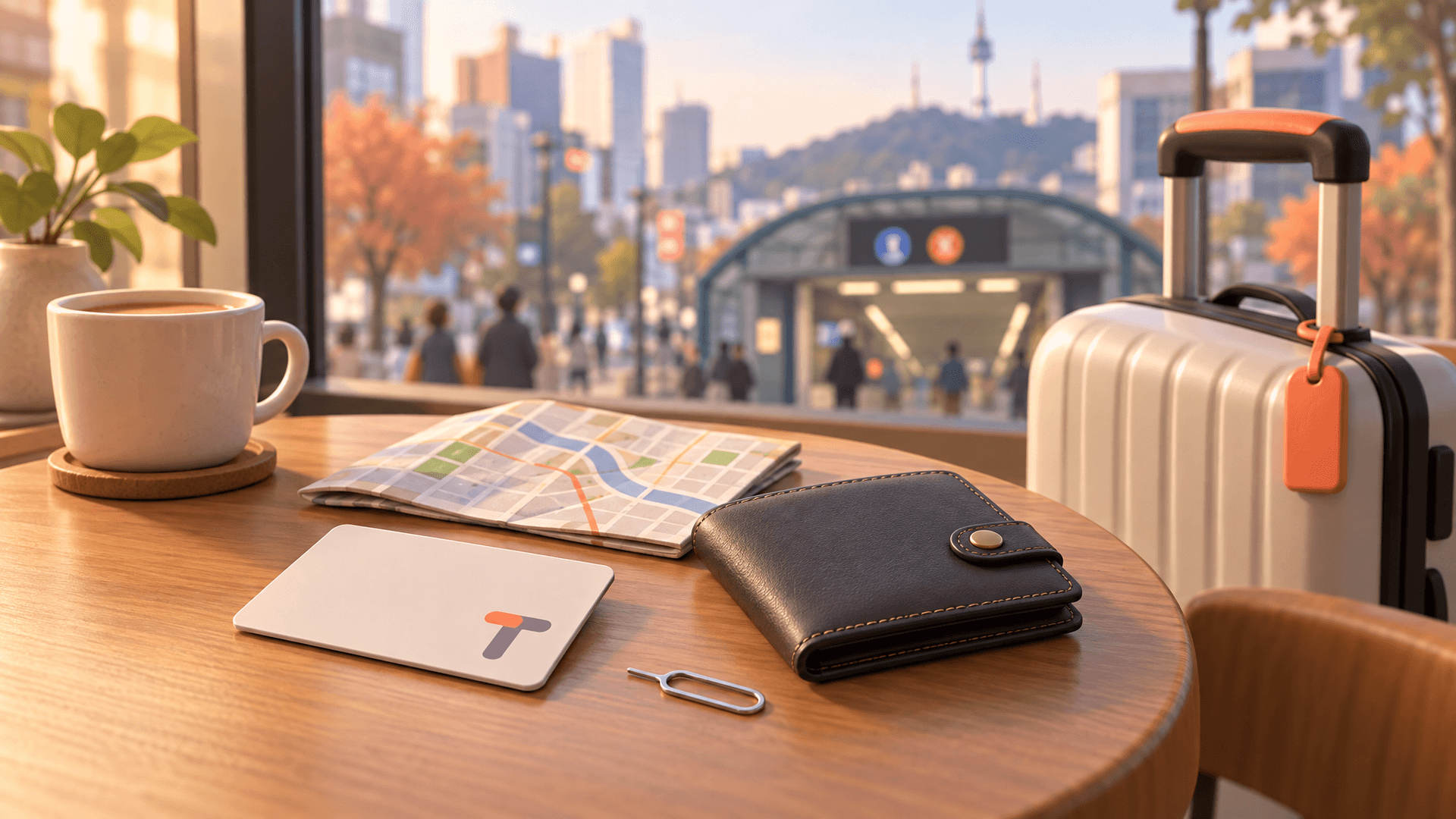
Seoul is one of the easiest big cities in Asia to land in, as long as you sort out five things early: mobile data, cash, a transit card, somewhere for your bags and the right map app. Get these done in your first hour and the rest of the trip just works.
Before you fly
Buy an eSIM and install it at home, on Wi-Fi. Check when the plan starts counting days: some start on install, most on the first connection in Korea.
Download Jinjja to find what’s good to eat and do around you, from your first meal off the plane to the last night out.
Download Naver Map or Kakao Map, Kakao T (taxis) and Papago (translation). Sign up while you still have your home number for SMS codes.
Bring a Visa or Mastercard, plus a small amount of cash in your home currency to exchange in the city.
1. Mobile data: eSIM, SIM or pocket Wi-Fi
Free Wi-Fi is everywhere, in the subway, cafés and most public spaces, but you will want your own data for maps and translation on the street.
eSIM: the easiest option if your phone supports it. Data-only plans are cheapest. Your home SIM keeps working for calls and bank codes.
Physical SIM with a Korean number: sold at the KT, SK Telecom and LG U+ counters in the Incheon arrivals hall. A local number helps with apps that only verify Korean numbers, like some delivery and booking apps.
Pocket Wi-Fi: worth it for a group sharing one connection, but it is one more thing to charge and return.
2. Money: cards first, a little cash
Korea is close to cashless. Cafés, restaurants, convenience stores, taxis and most shops take foreign Visa and Mastercard. American Express and UnionPay work in fewer places.
You still need some cash for:
Street food stalls and traditional markets.
Topping up a T-money card at most machines and convenience stores.
Small family-run restaurants that prefer cash, or older stores in smaller cities.
Where to exchange
Airport: convenient but the weakest rate. Change only what you need for the first day.
Money changers in the city: Myeong-dong and the areas around Hongdae and Itaewon have licensed changers with the best rates. Bring clean notes.
ATMs: look for machines marked Global or Foreign Card, in convenience stores and banks. Your bank may charge a fee on top of the ATM fee.
WOWPASS
WOWPASS is a prepaid card for visitors. Its kiosks in airports, hotels and subway stations exchange foreign cash straight onto the card, and the card also carries a separate T-money balance for transit. You pay a one-off issue fee of ₩6,000. It suits travellers who don’t want to use their home card abroad or who are bringing mostly cash.
환전
hwanjeon
currency exchange
3. Getting around: T-money or Climate Card
T-money
T-money is the standard tap card for the subway, buses and many taxis across the country. Buy one at a convenience store (CU, GS25, 7-Eleven) or a subway ticket machine. The card itself costs a few thousand won, and the balance is separate.
Tap on and off, on buses too. That is how fares and transfer discounts are calculated.
An adult subway ride in Seoul starts at ₩1,550 with a card, cheaper than a single-journey ticket.
Transfers between subway and bus within about 30 minutes are discounted, often free.
Top up with cash at station machines or at a convenience store counter.
Get leftover balance back at a convenience store before you fly home (small fee).
티머니 충전해 주세요
timeoni chungjeon hae juseyo
Please top up my T-money
Climate Card, unlimited rides
Seoul’s Climate Card has short-term passes for visitors: ₩5,000 for 1 day, ₩8,000 for 2, ₩10,000 for 3, ₩15,000 for 5 and ₩20,000 for 7 days, plus ₩3,000 for the card. It covers unlimited rides on the Seoul subway and Seoul city buses.
It pays off from about four rides a day. Since March 2026, many station machines on Lines 1–8 also take foreign credit cards for single tickets and Climate Card passes.
From the airport
AREX all-stop train: works with T-money, about an hour to Seoul Station with stops at Gimpo, Hongik University (Hongdae) and more.
AREX Express: non-stop to Seoul Station, faster, with a separate ticket.
Airport limousine buses: drop you near most big hotels, easy with luggage.
4. Luggage: lockers, storage and delivery
Arriving before check-in, or checking out with a late flight? You don’t have to drag a suitcase around the city.
Subway lockers: most big stations have smart lockers in several sizes. You pay at the screen, by card or T-money. Large lockers in tourist stations fill up by late morning.
Your hotel: almost every hotel and many guesthouses hold bags before check-in and after check-out for free. Just ask.
Luggage delivery: services at Incheon Airport and Seoul Station take your bags to your hotel the same day, or from your hotel to the airport, so you can go straight out sightseeing.
짐 보관할 수 있어요?
jim bogwanhal su isseoyo?
Can I store my luggage?
5. Maps: Naver and Kakao, not Google
For years Google Maps barely worked in Korea, because the government did not allow detailed map data to leave the country. That changed in February 2026, when the export was approved, and Google is now building full navigation for Korea. Until it is fully live, local apps are still much better for walking directions.
Naver Map: the most detailed. Has an English mode (Settings → Language), live subway and bus times, and tells you which exit and even which carriage to use.
Kakao Map: just as good for transit, with a clean interface. Pairs with Kakao T for taxis.
Search by the place’s Korean name or paste its address when the English name finds nothing.
몇 번 출구예요?
myeot beon chulguyeyo?
Which exit number?
First-hour checklist
Connect to data: turn on your eSIM or pick up your SIM at arrivals.
Exchange a small amount of cash, or top up your WOWPASS.
Buy a T-money card and load around ₩20,000–₩30,000.
Store or send your bags if your room isn’t ready.
Open Naver or Kakao Map, find your hotel’s exit and go.
Once that’s done, open Jinjja to see what’s good to eat around you. Your first Korean meal should be the best part of day one.